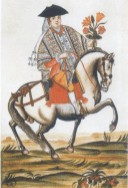
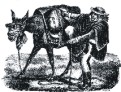
Trujillano aristocrat rider seen by Bishop Martínez de Compañón.
Jinete aristócrata trujillano visto por el Obispo Martínez de Compañón.
(...) The extension of its agricultural lands during the 18th century, was almost 22 thousand acres which still prevail (...)and in those days already there existed a very fine Line of Loose front end gaited Beast Blue Roans, and Red Roans (*), raised since the 16th century, in the surroundings of Ucupe, which belonged to the lands of Sanapo, and which owner was Don Hernan de Sanchez y Moreover. As well as other Browns, Dark Bay and some Overo-colored, of a certain Don Pedro de Leon who raised them further up from Oyotun (around the Nancho) and outstood for their noble temperament (Brio), and Loosness in the front end.
(*) Almendrado, is the Creole definition of the northern Aficionado when referring to the color of the Mantle comprised by the uniform combination of the three hairs common to the riding equine, the Sorrel-colored, the White and the Black, generally referred to as Roan.
(...) Other Notable citizens worthy to be remembered, are the Colchado, Reaño, Diaz, Rodriguez de Lozada, Andrade de Peñaranda, Lopez de Sandoval and Mendoza, the Polo (who later were also De Esteves), and the Estrada who married into the Figuerola of Lambayeque.
(...) The lapse of time between the two floods (1720/1728), was also uncertain and served for those who survived it, to think over and redirect the direction of their destinies. So, while some preferred to stay in San Roque de Lambayeque as occurred with several of the aforementioned families, other contemporaries approached their relatives of Trujillo del Peru, such as the Marqueses de Aranda; while the Ancient Noblemen De Esteves (who later became Vertiz, Razuri, and Goyburo; and also the Saavedra), Royal Tax Collectors at the peninsular Metropolis (Spain), also had multiple financial interests in Spanish America, and were furthermore Royal Commissioners to introduce the cultivation of tobacco in the neighboring valley of the Jequetepeque river, by appointment of his Majesty the King of Spain Don Felipe V (1700/46); y, for this reason, they moved towards there.
(...) Dusty, the Esteves arrived to their new home...This time, accompanied by their African slaves, Negroes and mulattos as Rounders up and mestizo Foremen as Mayordomos. All Muleteers by profession, and driving across the pampas of Chérrepe in Zaña and also of Lambayeque, the Improved Offspring of their Brown, Black, Bay and Blue Roans or Fierroles and their Black Roans almost as Black with scattered white hairs. Apart from their Mules which only amongst them added to more than two hundred for their employment; and among them, also their own Mounts brought to the north from the Ciudad de los Reyes (City of the Kings) their being entitled to it, both for their rank as for their lineage. It was the year 1748(...), and all that went on at the Intendance of Trujillo del Peru!
(...) La extensión de sus tierras agrícolas durante el siglo XVIII, eran de casi 22 mil acres que aun prevalecen (...)y en aquel entonces ya se ponderaba una Línea muy fina de Bestias Braceadoras Moras, Tordillas, y Almendradas(*) (Red Roans), criadas desde el siglo XVI anterior pasado, en los alrededores de Ucupe, que pertenecia a las tierras de Sanapo, y cuyo propietario lo era Don Hernan de Sánchez y Morover. así como también, otras Zainas , Castañas Oscuras, y algunas Overas, del tal Don Pedro de León, quien las criaba más arriba de Oyotun (por el Nancho), y sobresalían por su noble temperamento (Brío), y gran Juego de Manos.
(*) Almendrado, es la definición criolla del Aficionado norteño, para referirse al color del Manto compuesto por la mezcla uniforme de los tres pelos comunes alo equino caballar, el Alazan, el Blanco, y el Negro, generalmente referido como Ruano.
(…) Otros Criollos Notables que son de recordar son los Colchado, Reaño, Díaz, Rodríguez de Lozada, Andrade de Peñaranda. López de Sandoval y Mendoza, los Polo (que después también fueron De Esteves), y los Estrada que emparentaron con Figuerola de Lambayeque.
(...) El lapso de tiempo comprendido entre las dos inundaciones (1720/1728), también fue incierto y sirvió para aquellos que sobrevivieron, recapacitaran y tomaran otras direcciones en sus destinos. De esa manera, mientras algunos prefirieron ir a residir en San Roque de Lambayeque como sucediera con varias de las familias anteriormente mencionadas, otros contemporáneos se allegaron a su parentela de Trujillo del Perú, como los Marqueses de Aranda; mientras los Infanzones De Esteves (quienes después fueron Vertiz, Rázuri, y Goyburo; así como también, Saavedra.), Cobradores Reales de las Gabelas en la Metrópoli peninsular (España), con múltiples intereses mercantiles y financieros en Hispanoamérica, fueron nombrados Comisionados Reales para implantar el cultivo del tabaco en el vecino valle del río Jequetepeque, por encargo de su Majestad el Rey de España Don Felipe V (1700/46); y, por tales, hacia allí se trasladaron.
(...) Polvorientos pues, llegaron los De Esteves a su nuevo lar... Esta vez, acompañados de sus esclavos africanos, zambos y mulatos como Rodeadores y algún Capataz mestizo por Mayordomo. Todos Arrieros de profesión, y arreando por las pampas de Chérrepe desde Zaña y también de Lambayeque, la Recría de sus Bestias Zainas, Negras, Castañas, y Moras Azules o Fierroles, y sus Moras Oscuras casi prietas como si fueran Negras y Canosas.
Además de sus Mulas arrieras agregadas y contabilizadas ellas solas en más de doscientas para su menester; y de entre ellas, también sus propias Monturas traídas al norte desde la Ciudad de los Reyes por así corresponderles, tanto por su rango como por alcurnia. Corría el año de 1748(...), y aquello sucedía en la norteña Intendencia de ¡Trujillo del Perú!
No part of this publication may be reproduced, stored in a retrieval system, or transmitted, in any form or by any means- electronic, mechanical, recordings, or otherwise- without the prior written permission of Sr. Don Alfonso Figuerola-Saavedra, EQUUS PERUANOS™, Figuerola Peruvians, Figuerola Publishing and /or Figuerola Group INC. and it’s divisions. This does not exclude distributors, retailers, wholesalers, or any other agent representing Figuerola Group INC., and it’s divisions. Warning: Unauthorized reproduction of this publication is prohibited by federal law and is subject to federal prosecution. Further, please be advised that Figuerola Group INC. and it’s divisions actively and aggressively enforces its intellectual property rights to the fullest extent of the law.